Artificial intelligence is rapidly becoming part of every enterprise strategy. As organizations invest billions in GPU infrastructure, private AI platforms, and large-scale data centers, cybersecurity must evolve alongside these investments.
An AI data center is far more than a collection of servers. It represents one of an organization's most valuable collections of intellectual property, operational data, and computational resources. That makes it an attractive target for cybercriminals, nation-state actors, and insider threats alike.
Expanding the Attack Surface
AI introduces new risks that extend beyond traditional IT environments.
Training datasets may contain sensitive information. Machine learning models themselves represent valuable intellectual property. API endpoints expose inference services to the public. GPU clusters create high-value computing resources that attackers may attempt to hijack for cryptocurrency mining or unauthorized AI workloads.
At the same time, modern AI environments increasingly integrate operational technology, physical infrastructure, cloud services, and enterprise networks, expanding the number of potential entry points.
Identity Is the New Perimeter
Many successful cyberattacks no longer rely on sophisticated malware. Instead, they begin with compromised credentials.
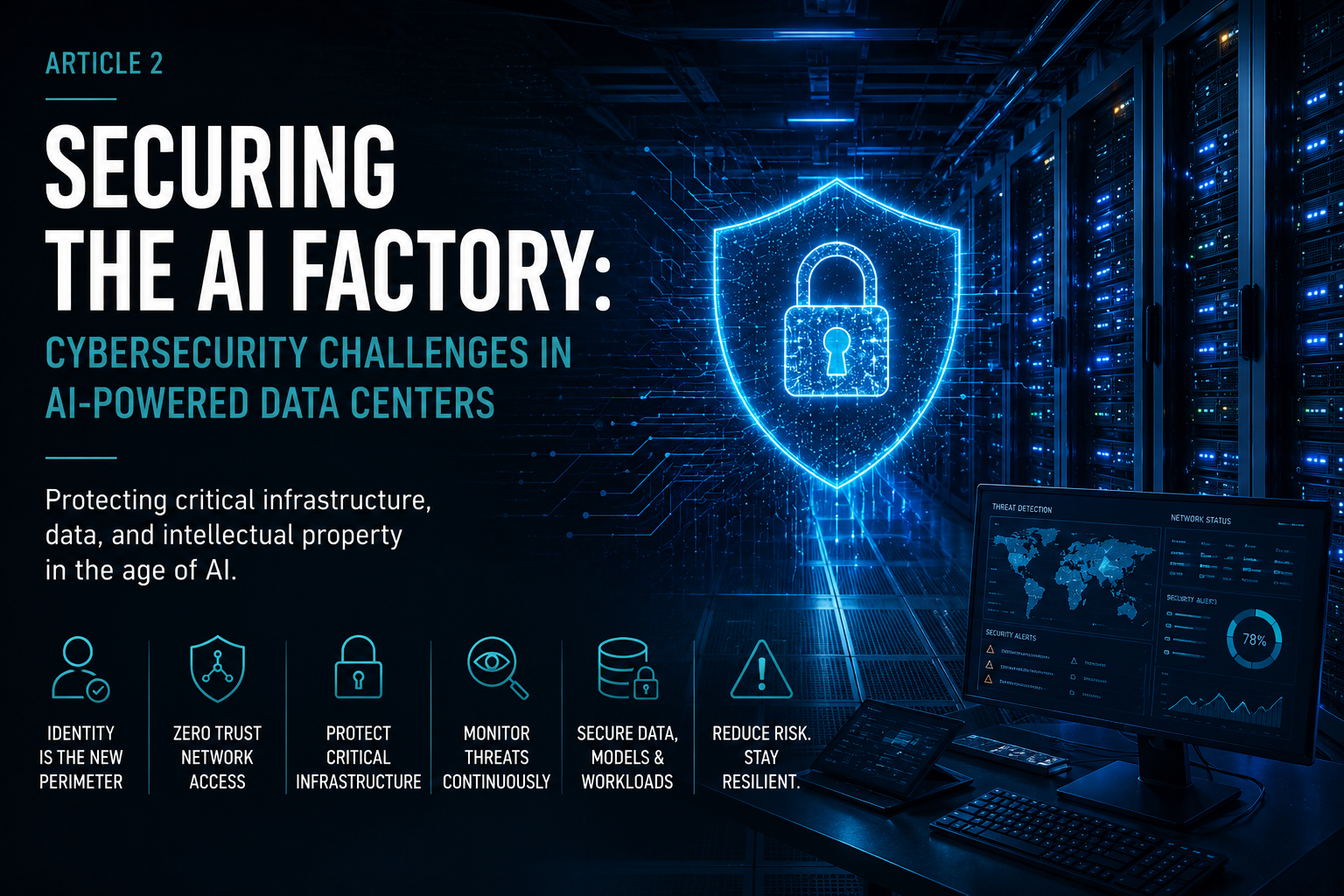
Strong identity management, phishing-resistant multi-factor authentication, privileged access controls, and continuous monitoring should form the foundation of any AI security strategy.
Zero Trust architectures help ensure that users, devices, and applications receive only the minimum level of access required to perform their functions.
Protecting Critical Infrastructure
The physical infrastructure supporting AI deserves the same level of protection as the digital systems it powers.
Electrical control systems, building management systems, backup generators, UPS equipment, and cooling systems increasingly connect to enterprise networks for monitoring and automation. These systems should be segmented, continuously monitored, and protected from unnecessary external access.
Cybersecurity is no longer confined to the server room. It extends to every component that keeps AI workloads operational.
Security by Design
Organizations deploying AI infrastructure should consider several guiding principles:
- Implement Zero Trust security models
- Protect privileged accounts with strong authentication
- Segment operational technology from corporate IT networks
- Monitor infrastructure continuously for anomalous behavior
- Maintain immutable backups and tested recovery procedures
- Establish governance for AI models, training data, and access controls
- Conduct regular security assessments of both IT and operational environments
Conclusion
As AI becomes central to business operations, its supporting infrastructure will become one of the highest-value targets within the enterprise.
Organizations that treat cybersecurity as a foundational design requirement, rather than a compliance exercise, will be better positioned to protect their investments while maintaining the resilience required for mission-critical operations.
The future of AI depends not only on computational performance, but also on trust, resilience, and secure infrastructure.