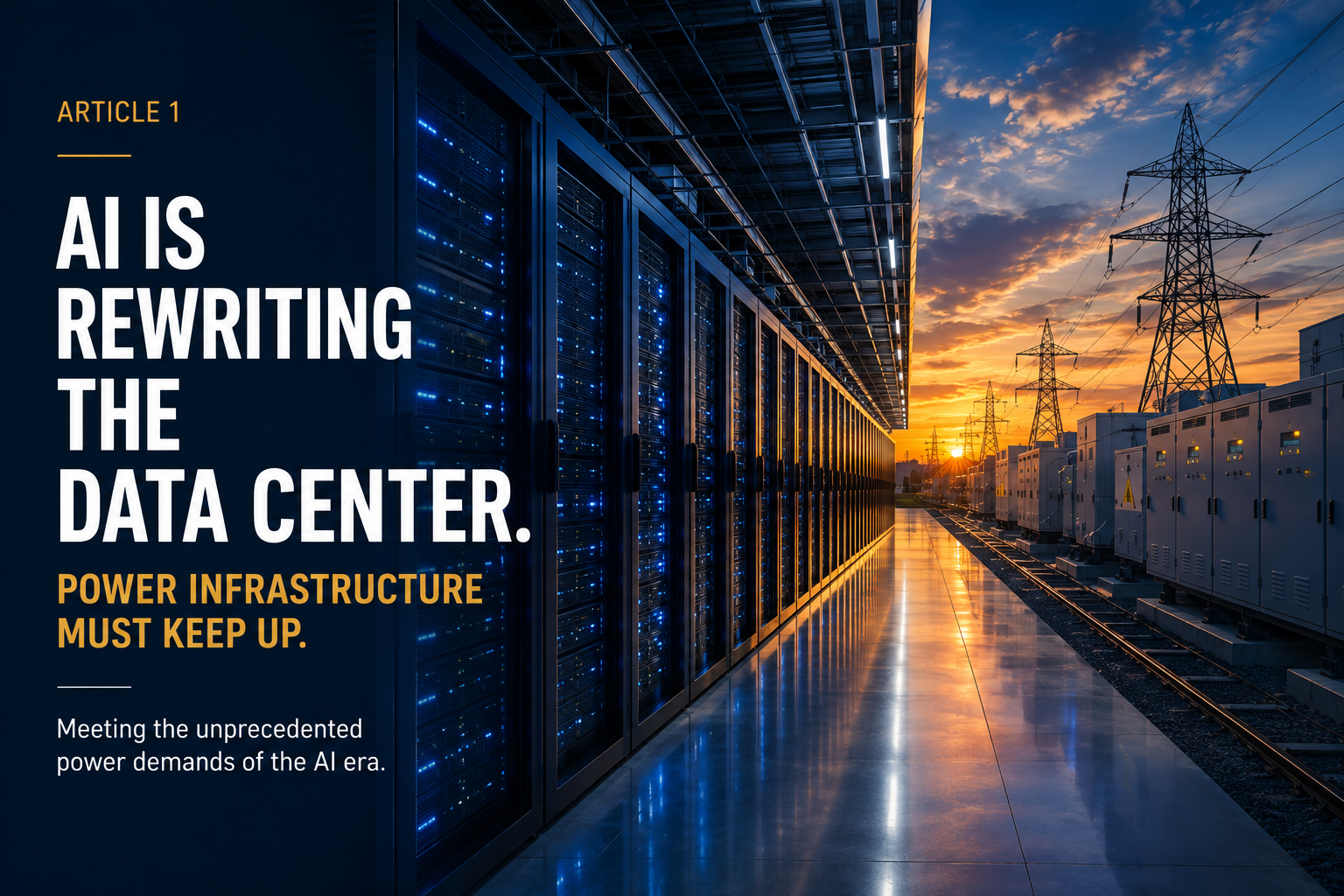
Artificial intelligence has quickly become one of the largest drivers of infrastructure investment in decades. While headlines often focus on GPUs, large language models, and software innovation, the real bottleneck is increasingly found elsewhere: electrical power.
Training and serving modern AI models requires infrastructure that is fundamentally different from traditional enterprise computing. High-performance GPU clusters routinely consume several times the power of conventional server deployments, pushing rack densities well beyond historical norms. Facilities originally designed for 10 to 20 kilowatts per rack are now being asked to support 100 kilowatts or more, fundamentally changing how data centers are designed, powered, and cooled.
This shift places unprecedented demands on electrical infrastructure.
The New Constraint
For years, compute capacity and networking defined the pace of digital transformation. Today, utilities, substations, transformers, switchgear, and cooling systems have become the limiting factors for many AI deployments.
Across North America and Europe, organizations are encountering extended utility interconnection timelines, constrained grid capacity, and long lead times for critical electrical equipment. Even companies with sufficient capital often find themselves waiting months, or even years, for the infrastructure required to energize new AI facilities.
Designing for AI at Scale
Supporting AI workloads requires a different engineering mindset.
Electrical systems must be designed with higher power densities, greater redundancy, and significantly more flexibility for future expansion. Cooling strategies increasingly include direct-to-chip liquid cooling and rear-door heat exchangers alongside traditional air-cooled designs. Backup power systems must accommodate larger sustained loads while maintaining the resiliency expected of mission critical environments.
Successful projects begin with integrated planning across electrical engineering, mechanical systems, networking, operations, and cybersecurity. AI infrastructure is no longer a collection of independent disciplines. It is an interconnected ecosystem where decisions in one area directly affect every other.
Beyond the Data Center
The growing demand for AI is also reshaping the broader electrical grid.
Utilities are evaluating new transmission capacity, hyperscale operators are investing in renewable generation and battery storage, and interest in nuclear energy has accelerated as organizations search for reliable carbon-free power sources capable of supporting continuous high-density computing.
As AI adoption expands, power availability will become a strategic business consideration rather than simply a facilities concern.
Looking Ahead
The next generation of AI will not be limited by advances in processors alone. It will be enabled by the engineers who design resilient electrical infrastructure capable of supporting those processors safely, efficiently, and reliably.
Organizations planning AI initiatives should begin with a simple question:
Can our infrastructure support where AI is headed, not just where it is today?
Those that answer that question early will be better positioned to scale as AI continues its rapid evolution.